Understanding house electrical systems begins with deciphering wiring diagrams, often found as PDF documents. These visual guides detail circuit layouts,
component locations, and safety measures for residential electrical work.
Accessing and interpreting these diagrams is crucial for DIY repairs, renovations, or simply understanding your home’s electrical infrastructure.
What is a House Electrical Wiring Diagram?
A house electrical wiring diagram, frequently encountered as a PDF, is a visual blueprint of your home’s electrical system. It’s a schematic representation, using standardized symbols, to illustrate the paths electricity takes from the service panel (breaker box) to outlets, lights, and appliances.
These diagrams aren’t necessarily artistic renderings; they prioritize clarity and technical accuracy. A PDF format allows for easy distribution and viewing on various devices. They show how circuits are connected, the wire gauges used, and the location of each electrical component.
Essentially, it’s a map for electricity, helping homeowners and electricians understand, troubleshoot, and modify the electrical infrastructure safely and effectively.
Why You Need a Wiring Diagram
Having a house electrical wiring diagram, often in PDF format, is invaluable for several reasons. Firstly, it’s essential for safe DIY electrical work. Attempting repairs or additions without a diagram is risky and potentially dangerous, violating safety codes.
Secondly, a diagram simplifies troubleshooting. When an outlet fails or a circuit trips, the diagram helps pinpoint the problem’s source quickly. Thirdly, it’s crucial for home renovations, ensuring new wiring integrates seamlessly with the existing system.
Finally, a PDF diagram is a valuable record for future reference, aiding in maintenance and emergency situations. It provides peace of mind, knowing you have a clear understanding of your home’s electrical layout.
Understanding Electrical Symbols
Decoding a house electrical wiring diagram PDF requires familiarity with standard electrical symbols. These pictograms represent components like outlets, switches, lights, and the electrical panel. Common symbols include circles for lights, zigzags for ground connections, and various shapes for different switch types.
Understanding these symbols is critical for accurately interpreting the diagram’s information. Resources like online guides and electrical handbooks provide comprehensive symbol lists. Ignoring these symbols can lead to misinterpretations and potentially dangerous mistakes during electrical work.
Mastering electrical symbols empowers you to confidently navigate and understand the complexities of your home’s wiring system, as depicted in the PDF diagram.

Components of a Typical House Wiring System
House wiring PDF diagrams illustrate key elements: the electrical panel, various wiring types, outlets, and switches. Understanding these components is vital for safe and effective work.
Electrical Panel (Breaker Box)
The electrical panel, often called a breaker box, is the central distribution point for your home’s electrical system; House wiring diagrams PDF versions clearly depict its layout, showing each circuit breaker and its corresponding amperage rating.
Understanding the panel is crucial; each breaker protects a specific circuit, preventing overloads and potential fires. Diagrams illustrate how circuits branch out from the panel to power outlets, lights, and appliances throughout the house. Identifying the correct breaker for a specific area is essential before undertaking any electrical work.
Modern panels often include a main breaker to disconnect all power, and may also feature Ground Fault Circuit Interrupters (GFCIs) and Arc Fault Circuit Interrupters (AFCIs) for enhanced safety. PDF diagrams will often label these features, aiding in troubleshooting and maintenance.
Wiring Types (Romex, Conduit)
House electrical wiring diagrams PDF formats meticulously detail the types of wiring used throughout a home. Commonly, you’ll encounter Non-Metallic Sheathed Cable (Romex), a flexible plastic-jacketed wire used for most interior wiring. Diagrams will show Romex runs, indicating wire gauge (thickness) and color coding for hot, neutral, and ground wires.
Alternatively, Electrical Metallic Tubing (EMT) or Rigid Metal Conduit are used for more robust applications, often in exposed areas or where greater protection is needed. PDF diagrams illustrate conduit runs, showing how wires are pulled through and secured.
Understanding these distinctions is vital; diagrams help identify wiring types for safe repairs or modifications. Proper identification ensures compatibility with components and adherence to electrical codes.
Outlets and Receptacles
House electrical wiring diagrams PDF versions clearly illustrate the placement and wiring of outlets and receptacles. These diagrams depict standard 15-amp and 20-amp receptacles, showing how they connect to branch circuits. Crucially, they differentiate between outlets controlled by switches and always-on receptacles.
GFCI (Ground Fault Circuit Interrupter) and AFCI (Arc Fault Circuit Interrupter) outlets are also specifically marked, highlighting their protective functions and required locations – typically bathrooms, kitchens, and bedrooms. PDF diagrams will indicate wiring configurations for these safety devices.
Accurate interpretation of these diagrams is essential for safe outlet replacement or addition, ensuring correct wiring and adherence to electrical codes.
Switches (Single-Pole, Three-Way)
House electrical wiring diagrams PDF formats meticulously detail switch configurations, notably single-pole and three-way switches. Single-pole switches, controlling a light from one location, are straightforwardly represented, showing the hot wire interruption. However, three-way switches, enabling control from two locations, require careful diagram study.
PDF diagrams illustrate the traveler wires connecting the two three-way switches, alongside the common terminals. Understanding this wiring is vital for troubleshooting or installing three-way circuits. Diagrams also show switch loop wiring, where the power source reaches the light fixture through the switch.
Correct interpretation prevents wiring errors and ensures proper switch functionality, enhancing home convenience and safety.
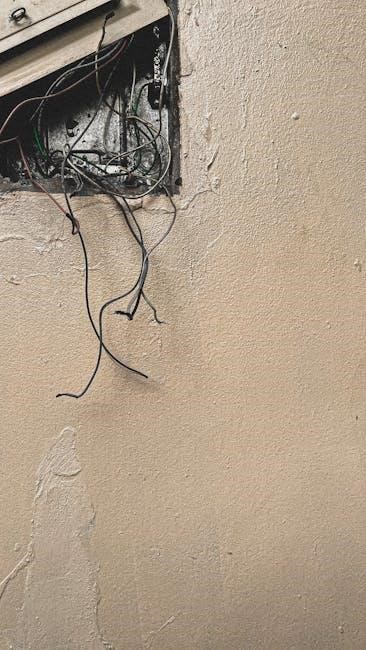
Decoding a House Electrical Wiring Diagram PDF
Successfully interpreting a house electrical wiring diagram PDF requires understanding its symbols, legend, and circuit paths for safe and effective work.
Reading the Legend
The legend is the key to unlocking the secrets within any house electrical wiring diagram PDF. It meticulously defines each symbol used, translating abstract shapes into recognizable electrical components. Common symbols represent outlets, switches, light fixtures, and the electrical panel itself.
Understanding these symbols is paramount; a misinterpretation can lead to incorrect wiring and potentially dangerous situations. Pay close attention to variations in symbols, as subtle differences can indicate different types of devices or wiring configurations. For example, a single-pole switch differs visually from a three-way switch.
The legend will also explain line types – solid lines for conductors, dashed lines for conduit, and dotted lines for signal paths. Carefully studying the legend before attempting to trace any circuit is a crucial first step, ensuring accurate interpretation of the diagram PDF.
Tracing Circuit Paths
Tracing circuit paths within a house electrical wiring diagram PDF involves following the lines representing conductors from the electrical panel to the various outlets, switches, and fixtures. Begin at the breaker corresponding to the circuit you’re investigating and systematically track its route.
Pay attention to how the lines connect components; this illustrates the flow of electricity. Note any junction boxes along the path, where multiple wires are joined. Understanding these connections is vital for troubleshooting.
Use a highlighter or pencil to visually follow the path, making it easier to identify the circuit’s complete route; Remember that diagrams may not always represent physical layouts perfectly, but they accurately depict electrical connections. Careful tracing within the PDF is key.
Identifying Branch Circuits
Branch circuits, clearly depicted in a house electrical wiring diagram PDF, are the individual circuits extending from the main electrical panel to power specific areas or appliances. Each circuit is protected by a dedicated breaker, labeled with its amperage rating.
Identifying these circuits involves correlating the diagram’s labeling with the breaker box. Look for notations indicating what each circuit serves – for example, “Living Room Lights” or “Kitchen Receptacles.”
Understanding branch circuit assignments is crucial for safe electrical work. Never work on a circuit without first identifying its corresponding breaker and switching it off. The PDF diagram provides this essential information for proper circuit management.
Common Wiring Configurations
House electrical wiring diagram PDFs commonly illustrate standard layouts: lighting, appliance, and dedicated circuits. These diagrams reveal typical wiring for kitchens, HVAC systems, and more.
Understanding these configurations aids in troubleshooting and planning electrical projects within your home.
Standard Lighting Circuits
House electrical wiring diagram PDFs frequently showcase standard lighting circuits, typically utilizing 14-2 or 12-2 Romex cable. These circuits generally operate at 120 volts and are protected by a 15 or 20-amp circuit breaker within the electrical panel.
Diagrams illustrate how multiple light fixtures are wired in parallel, allowing each fixture to function independently. Switches, often single-pole, control the flow of electricity to these lights. PDFs will detail the wiring path from the breaker panel, through the switch, and finally to the light fixture(s).
Understanding these basic circuits is fundamental for identifying issues like flickering lights or non-functional fixtures. Careful study of the diagram reveals how to safely trace the circuit and perform basic repairs, though professional help is recommended for complex problems.
Appliance Circuits (Kitchen, Laundry)

House electrical wiring diagram PDFs dedicate significant detail to appliance circuits, particularly in kitchens and laundry rooms. These circuits often require dedicated 20-amp breakers due to the higher power demands of appliances like refrigerators, dishwashers, washing machines, and dryers;
Diagrams illustrate the use of 12-2 Romex wiring for these circuits, ensuring sufficient current-carrying capacity. GFCI (Ground Fault Circuit Interrupter) protection is commonly shown near kitchen countertops and laundry areas for safety. PDFs will clearly show receptacle wiring and dedicated circuit runs.
Interpreting these diagrams helps understand appliance power requirements and proper circuit loading. Always consult the diagram before attempting any work on appliance circuits, prioritizing safety and adherence to electrical codes.
Dedicated Circuits (HVAC, Water Heater)
House electrical wiring diagram PDFs emphasize dedicated circuits for high-demand appliances like HVAC systems and water heaters. These circuits require isolation to prevent overloading and ensure reliable operation. Diagrams typically show these utilizing heavier gauge wiring, often 10-2 or 8-2 Romex, depending on the appliance’s amperage draw.
HVAC circuits frequently necessitate double-pole breakers, providing 240 volts. Water heater circuits may also require 240 volts, depending on the model. PDFs will illustrate the direct connection from the electrical panel to the appliance, bypassing intermediate outlets.
Understanding these dedicated circuits through diagrams is vital for safe and efficient operation. Always verify the appliance’s power requirements before working on these circuits.

Safety Precautions When Working with Wiring Diagrams
Before any electrical work, consult the house electrical wiring diagram PDF. Always disconnect power at the breaker, verify with a tester, and understand grounding.
Turning Off Power at the Breaker
Crucially, before referencing any house electrical wiring diagram PDF and commencing work, completely disconnect power at the main electrical panel. Locate the circuit breaker corresponding to the circuit you’ll be working on – the diagram will be invaluable here. Firmly switch the breaker to the “OFF” position;
Never assume the breaker is off; always double-check using a non-contact voltage tester. Test all wires at the work location to confirm zero voltage. Ignoring this step poses a severe electrocution risk. Proper breaker identification, aided by the diagram, prevents accidental energization of other circuits. Remember, safety is paramount; treat every wire as live until proven otherwise. Document which breaker you switched off for easy restoration later.
Using a Voltage Tester
After switching off the relevant breaker – as identified using your house electrical wiring diagram PDF – always verify the power is off with a voltage tester. Utilize a non-contact voltage tester for initial checks; it detects voltage without direct contact. Then, employ a multimeter for precise voltage readings, confirming zero volts between hot, neutral, and ground wires.
Ensure the tester is functioning correctly by testing it on a known live circuit before and after verifying the de-energized circuit. Never rely solely on visual inspection. Understanding tester operation is vital; incorrect usage can provide false readings. Regularly check battery levels. Always assume wires are live until proven otherwise with a reliable tester.
Understanding Grounding and Bonding
Referring to your house electrical wiring diagram PDF, grounding and bonding are critical safety components. Grounding connects to earth, providing a path for fault current, while bonding connects non-current-carrying metal parts. These systems minimize shock hazards and prevent electrical fires.
Diagrams illustrate grounding electrode conductors, connecting the panel to ground rods or water pipes. Bonding jumpers connect metal boxes, conduit, and appliance frames. Proper grounding and bonding ensure equal potential, diverting dangerous currents. Inspect these connections regularly for corrosion. Incorrect grounding/bonding can render safety devices ineffective, so consult a professional if unsure.

Finding and Utilizing PDF Resources
Locating a house electrical wiring diagram PDF involves online databases, manufacturer websites, and local building code resources for accurate schematics.
Online Databases of Wiring Diagrams
Numerous online platforms offer extensive collections of house electrical wiring diagram PDFs. These databases frequently categorize diagrams by house type, year built, or specific electrical components. Searching these resources often requires knowing details about your home’s construction and electrical system.
Popular websites compile diagrams submitted by users and professional electricians, creating a collaborative resource. However, always verify the accuracy of any diagram found online, as errors can be dangerous. Cross-referencing with manufacturer specifications and local building codes is highly recommended. Some sites may require a subscription or registration to access the full library of PDF documents.
Remember to prioritize diagrams that clearly indicate circuit paths, component locations, and safety information. Carefully review the legend to understand the electrical symbols used in the diagram.
Manufacturer-Specific Diagrams
Obtaining wiring diagrams directly from the manufacturer of your electrical panel or specific appliances is often the most reliable source. These PDF documents are tailored to the exact model and configuration of your equipment, ensuring accuracy and detail.
Many manufacturers provide these diagrams on their websites, often within a support or downloads section. You’ll typically need the model number and serial number of your device to locate the correct diagram. Older equipment may require contacting the manufacturer directly for access to these resources.
Manufacturer diagrams often include detailed schematics, component lists, and troubleshooting guides. Utilizing these resources can significantly simplify complex electrical work and ensure safe and effective repairs.
Local Building Code Resources
Your local building department is a valuable source for information regarding electrical codes and potentially, wiring diagrams. While they typically don’t provide PDF diagrams for existing homes, they can clarify code requirements impacting electrical work.
Building departments often maintain records of approved plans, which may include wiring diagrams submitted during initial construction or significant renovations. Accessing these records might require a formal request and associated fees.
Understanding local amendments to the National Electrical Code (NEC) is crucial for safe and compliant electrical projects. Consulting with a local inspector can ensure your work meets all applicable regulations, even without a specific wiring diagram.

Troubleshooting with a Wiring Diagram
A house electrical wiring PDF simplifies fault finding; identify shorts, opens, and ground faults by tracing circuit paths and verifying component connections.
Identifying Short Circuits

Utilizing a house electrical wiring PDF, pinpointing short circuits becomes a systematic process. A short circuit occurs when electricity bypasses its intended path, creating an unintended low-resistance connection. Examine the diagram to trace the circuit’s expected route from the electrical panel to the affected outlet or fixture.
Look for deviations from this path – any unintended connections between hot (live) and neutral or ground wires. PDF diagrams often highlight wire colors, aiding in visual identification. Consider that damaged insulation or loose connections can cause shorts. Verify that all components within the circuit are correctly wired according to the diagram. Remember to always disconnect power at the breaker before investigating!
Carefully inspect for signs of burnt wiring or melted insulation, which are indicators of a past or present short circuit. Confirm that no wires are touching metal surfaces they shouldn’t. A thorough review of the PDF, combined with careful visual inspection, will help isolate the source of the short.
Locating Open Circuits
Employing a house electrical wiring PDF, locating open circuits requires a methodical approach; An open circuit signifies a break in the electrical pathway, preventing current flow. Begin by tracing the circuit on the diagram from the breaker to the non-functioning device.
Identify all connections – outlets, switches, and fixtures – along the route. Utilize a voltage tester to check for power at each point. A lack of voltage indicates a potential break before that location. PDF diagrams are invaluable for confirming correct wiring configurations at each connection.
Inspect wire nuts, terminals, and switch contacts for looseness or corrosion. Consider that a tripped breaker or blown fuse can simulate an open circuit. Remember safety first – disconnect power before physical inspection. A systematic check, guided by the PDF, will reveal the break in the circuit.
Diagnosing Ground Faults
Utilizing a house electrical wiring PDF, diagnosing ground faults demands careful attention. A ground fault occurs when current deviates from its intended path, flowing to ground – a dangerous situation. Begin by examining the PDF to understand the grounding system within the circuit.
Identify all grounded components – metal boxes, appliance chassis, and grounding wires. Employ an insulation resistance tester (megohmmeter) to check for resistance between hot wires and ground. Low resistance indicates a fault. PDF diagrams help pinpoint potential fault locations.
Inspect for damaged insulation, loose connections, or moisture near grounded components. Remember that Ground Fault Circuit Interrupters (GFCIs) protect against these faults. Always disconnect power before investigation. A systematic approach, guided by the PDF, is crucial for safe and effective diagnosis.

DIY vs. Professional Help
While a house wiring PDF aids DIY efforts, complex issues demand a licensed electrician. Permits, inspections, and legal compliance often necessitate professional expertise for safety and code adherence.
When to Call an Electrician
Even with a detailed house electrical wiring diagram PDF in hand, certain situations unequivocally require a qualified electrician. Any work involving the electrical panel – breaker box – should be left to professionals due to the inherent dangers of high voltage. If the diagram reveals complexities beyond your understanding, or if you encounter issues like recurring tripped breakers, burning smells, or sparking, immediately cease work and contact an electrician.
Furthermore, any modifications to existing wiring, adding new circuits, or working with 240-volt appliances (like HVAC systems or water heaters) necessitate professional expertise. Ignoring these warnings can lead to fire hazards, electrical shock, and code violations. Remember, safety is paramount, and a professional ensures the work is done correctly and legally.
Permitting and Inspections
Before undertaking significant electrical work, even with a comprehensive house electrical wiring diagram PDF, investigate local permitting requirements. Many jurisdictions mandate permits for alterations to electrical systems to ensure compliance with safety codes. These permits typically involve submitting your wiring plans – potentially derived from the PDF – for review.
Following completion of the work, a qualified electrical inspector will assess the installation against the approved plans and the National Electrical Code (NEC). This inspection verifies the safety and functionality of the wiring. Failing to obtain necessary permits or pass inspection can result in fines, require rework, and potentially void your homeowner’s insurance.
Legal Considerations
Incorrect electrical work, even when guided by a house electrical wiring diagram PDF, can carry significant legal ramifications. Performing electrical tasks without proper licensing, where required, is often illegal and can lead to substantial penalties. Furthermore, substandard wiring resulting from misinterpretation of the PDF or improper installation can create liability issues.
If faulty wiring causes damage, injury, or even death, homeowners could face lawsuits. Insurance companies may deny claims related to unpermitted or non-compliant electrical work. Always prioritize safety and adherence to local codes, and when in doubt, consult a licensed electrician to avoid potential legal complications and ensure your home’s electrical system is legally sound.